
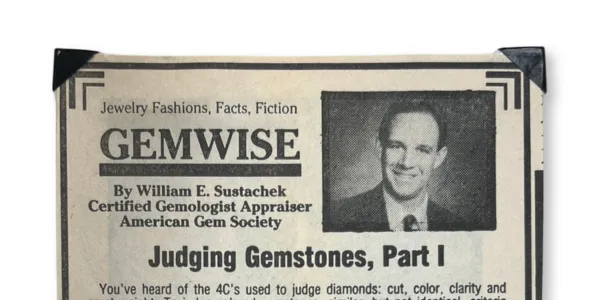
You've heard of the 4C's used to judge diamonds: cut, color, clarity and carat weight. To judge colored gemstones, similar, but not identical, criteria come into play.
Color is the most important consideration.
The most valued colored gemstones are those with a rich color, not too pale and not too dark. The human memory for color needs assistance, however. These days informed jewelers have moved away from such phrases as "pigeon's blood" (once used to describe ruby) and "banana-peel" (once used to describe yellow sapphires). Less lively, but more accurately, any one of several master color grading systems are now used by the jewelry industry.
Color grading has not been standardized in the jewelry industry. Still, the goal is to find the color that pleases you most for the gem you buy.
The way a colored gemstone is cut affects the color of the gem. Many colored gemstones have zones of color, areas where color is present or richer than in other areas of the gem. The cutter's task is to orient the rough to obtain the best color in the finished gem. For certain gems such as kunzite (a pink gem) or blue zircon, cutters cut the gem with a slightly heavier pavilion, or botton, than a diamond would be cut in order to improve color saturation.
The next article will explore how a colored gemstone is judged according to clarity, carat weight, and other considerations. We would be glad to discuss our fine selection of colored gemstones with you.
Color is the most important consideration.
The most valued colored gemstones are those with a rich color, not too pale and not too dark. The human memory for color needs assistance, however. These days informed jewelers have moved away from such phrases as "pigeon's blood" (once used to describe ruby) and "banana-peel" (once used to describe yellow sapphires). Less lively, but more accurately, any one of several master color grading systems are now used by the jewelry industry.
Color grading has not been standardized in the jewelry industry. Still, the goal is to find the color that pleases you most for the gem you buy.
The way a colored gemstone is cut affects the color of the gem. Many colored gemstones have zones of color, areas where color is present or richer than in other areas of the gem. The cutter's task is to orient the rough to obtain the best color in the finished gem. For certain gems such as kunzite (a pink gem) or blue zircon, cutters cut the gem with a slightly heavier pavilion, or botton, than a diamond would be cut in order to improve color saturation.
The next article will explore how a colored gemstone is judged according to clarity, carat weight, and other considerations. We would be glad to discuss our fine selection of colored gemstones with you.